
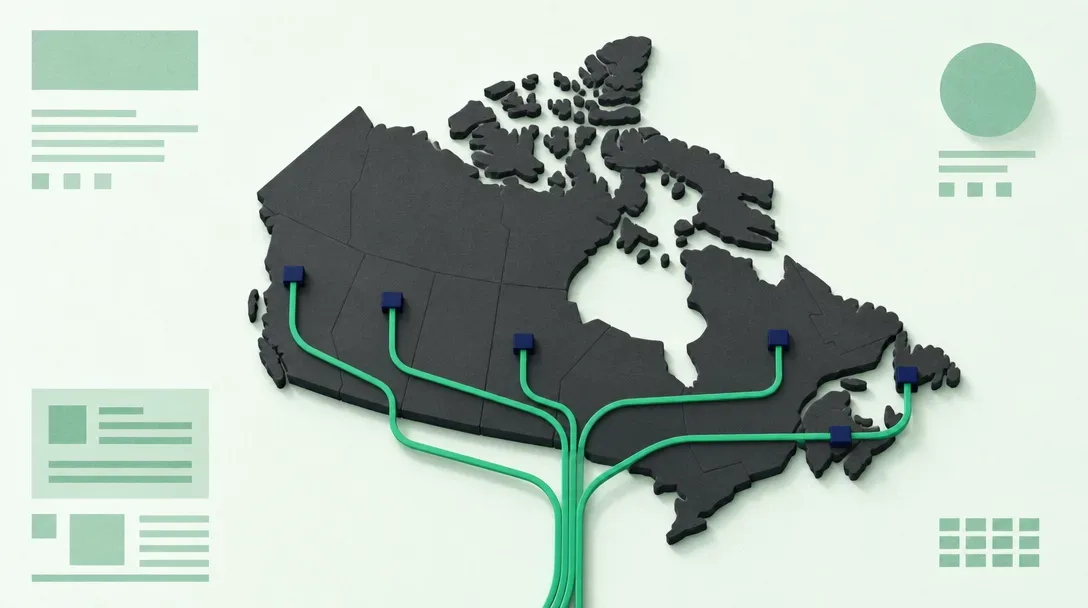
Selecting Canadian residential proxies requires a choice between the high-volume capacity of datacenter servers and the high-trust reputation of genuine home-user connections. Unlike datacenter proxies that originate from server farms and face frequent blocks, residential proxies route traffic through IP addresses assigned by ISPs such as Bell, Rogers, or Telus to actual households. This distinction is critical for bypassing anti-bot systems that monitor for hosting provider signatures.
This guide settles how to audit your proxy provider’s technical stack to ensure you are receiving authentic Canadian traffic rather than misattributed or spoofed headers. You will learn to evaluate the difference between rotating pools for scraping and static residential IPs for session stability, while using GPURated’s benchmarking methodology to verify physical termination in cities like Toronto or Vancouver. By the end of this analysis, you will be able to calculate the total cost of ownership based on IP cleanliness and connection success rates rather than just the initial price per gigabyte.
Key takeaways
- Verify that your provider uses real Canadian ISP ASN data rather than mislabeled datacenter ranges to avoid immediate site bans.
- Prioritize SOCKS5 protocols over HTTP when running high-concurrency browser automation to maintain session stability in the Canadian market.
- Audit the geographical distribution within Canada to ensure your traffic originates from the specific province required for localized content delivery.
- Select providers that offer granular rotation controls to prevent IP leakage during sensitive financial or market-access transactions.
Table of contents
- Canadian residential proxies route traffic through genuine home-user internet connections.
- The underlying mechanism relies on P2P networks and ISP-assigned ASNs.
- Static residential IPs offer stability where rotating pools fail.
- Misattributed geolocation creates a false sense of security.
- Performance degradation occurs when peer-to-peer nodes go offline.
- Audit the provider's technical stack before committing capital.
- Calculate the total cost of ownership beyond the price per gigabyte.
- Frequently asked questions
- How do I verify if a Canadian proxy is truly residential?
- Which Canadian ISPs are most commonly represented in proxy pools?
- Are Canadian residential proxies faster than datacenter proxies for scraping?
- What is the average cost per GB for high-quality Canadian residential IPs?
- Do Canadian residential proxies support SOCKS5 for secure automation?
- Selecting Your Canadian Residential Proxy Infrastructure
Canadian residential proxies route traffic through genuine home-user internet connections.
Use IP addresses that appear indistinguishable from local consumer traffic to secure high-integrity data from Canadian web targets. A Canadian residential proxy routes your requests through hardware connected to a domestic internet service provider (ISP). Major Canadian carriers like Bell, Rogers, or Telus assign these IPs to physical residential addresses, unlike generic proxy types. Deploying these proxies gives your connection the digital signature of a genuine homeowner. This makes them essential for localized market research or sensitive account management within the region.
Mimic legitimate user behavior to gain high anonymity. Web servers trust this incoming traffic because the IPs belong to a standard consumer pool. Select a vetted provider if your project requires scaling operations without triggering security blocks. Consult the Top Proxy Providers 2026: Residential, ISP & Datacenter guide for a technical comparison of current market options and to ensure your service maintains a clean IP reputation. These proxies allow you to navigate geo-fenced content and localized pricing models that external users cannot access.
Distinguish these residential options from datacenter proxies to avoid mass-detection. Datacenter proxies originate from secondary server farms rather than home connections. Their IP ranges are easily identified by anti-bot systems as non-human traffic, even though they often offer higher speeds. Most major Canadian platforms employ advanced fingerprinting that can instantly flag and block entire subnets associated with data centers. Opt for residential IPs to bypass these bulk-blocking filters, because the traffic originates from the same ASN blocks used by everyday Canadian citizens.
The underlying mechanism relies on P2P networks and ISP-assigned ASNs.
To acquire authentic Canadian residential proxies, you must understand that these are not server-side assets but rather IP addresses belonging to real household internet connections. Proxy providers build these networks by integrating Software Development Kits (SDKs) into consumer applications or through direct partnerships with hardware manufacturers. When a user installs a participating app and agrees to share their idle bandwidth, their home IP becomes a node in the provider's P2P network. This allows your traffic to exit through a residential router, inheriting the digital footprint of a standard Canadian consumer.
The technical cornerstone of this legitimacy is the Autonomous System Number (ASN). An ASN is a unique identifier for a collection of IP prefixes managed by a single entity. For a proxy to function effectively, its ASN must be registered to a major Canadian Internet Service Provider (ISP) such as Rogers, Bell, or Telus. Websites use ASN databases to distinguish between high-trust residential traffic and low-trust data center traffic. If your proxy provider claims to offer residential IPs but the ASN points to a hosting company, your requests will likely be blocked or challenged with CAPTCHAs.
Target websites in Canada employ sophisticated geolocation and IP intelligence services to verify traffic origin. When you route a request through a peer in Toronto or Vancouver, the target server checks the IP’s metadata. It looks for a "Residential" usage type and a location that matches the expected latency for that region. Because these IPs are assigned to physical homes by local ISPs, they bypass the firewall rules that typically flag bulk traffic coming from commercial server farms. This makes them essential for tasks that require a high degree of anonymity and local relevance.
To audit the integrity of your proxy pool, perform a manual lookup on a subset of your assigned IPs using an external database. Verify that the ISP field matches a known Canadian consumer provider and that the usage type is not listed as "Data Center" or "VPN." You should also confirm if the provider allows for city-level targeting, which is necessary for localized scraping or account management. For a deeper look at global network distribution, you can review Hosting Providers by Country (19+) to compare how Canadian residential infrastructure stacks up against other regions. Check the provider’s current pricing and documentation on their website to ensure their ASN transparency policies have not changed.
Static residential IPs offer stability where rotating pools fail.
Match your proxy selection to your session length instead of focusing on pool size. Use rotating residential proxies for high-volume data harvesting or web scraping within Canadian retail and search markets. These pools cycle through homeowner connections to distribute requests and bypass rate limits. Avoid these for tasks that require a persistent identity. If your software switches IPs while you are logged into a secure portal, the platform will likely flag the session as suspicious.

Choose static residential IPs, also known as ISP proxies, if you are a remote worker or trader who needs a consistent Canadian presence. These provide a single, dedicated address from a Canadian internet service provider that remains unchanged throughout your contract. Use this consistency to access banking interfaces, corporate VPNs, or crypto exchanges. These platforms often trigger "impossible travel" alerts if a user appears to move between provinces in seconds. A static IP creates a stable digital footprint that looks like a resident working from a fixed home office.
Use gpurated to audit your connection and confirm the static IP is identified as a residential type. Many platforms block data center assignments by default, so verifying this classification is essential. Check the specific ISP and the current cost per IP on the vendor’s pricing page before you buy, as rates and partnerships change. Prioritize the stability of a single, clean address over the size of a rotating pool for long-term account management.
| Feature | Rotating Residential | Static Residential (ISP) |
|---|---|---|
| IP Persistence | Changes per request or at set intervals | Assigned address remains constant |
| Primary Use Case | Large-scale scraping and data collection | Account management and remote work |
| Detection Risk | High risk of triggering session security alerts | Low risk of being flagged for IP hopping |
| Pool Diversity | Access to millions of rotating nodes | Limited to specific purchased addresses |
Misattributed geolocation creates a false sense of security.
Verify the physical location of your Canadian residential proxies to avoid detection. The market remains saturated with providers that misrepresent their inventory to inflate the perceived size of their local pools. You may purchase access to a pool labeled for Montreal or Vancouver, only to find the traffic actually originates from an overseas datacenter using a manipulated X-Forwarded-For header. This misattribution bypasses basic geolocation lookups but fails against the deep packet inspection and behavioral analysis used by high-security Canadian targets. If the underlying infrastructure is not truly residential or is physically located outside Canadian borders, your request will likely be flagged for "impossible travel" or proxy usage.
Validate your connection by implementing the gpurated benchmarking methodology. Start by measuring round-trip time (RTT) from a known geographic point. If you are testing a proxy supposedly located in Toronto from a server in the Northeastern United States, the latency should be consistently low. Significant spikes or base latencies exceeding what physics allows for that distance indicate that the IP is being tunneled from a distant region. Consistently high latency is a primary indicator that the "Canadian" label is a software-level mask rather than a physical reality.
Perform a traceroute to map the network path instead of relying on simple pings. Analyze the final three hops before the destination IP. If these hops resolve to major Canadian internet service providers (ISPs) like Bell, Rogers, or Telus, the residential claim is likely valid. However, if the traceroute terminates in a known datacenter facility or hops through international exchange points in London or Tokyo before reaching the "Canadian" IP, the provider is spoofing the location. For those concerned with how these diagnostic tests interact with data handling, reviewing the gpurated Privacy Policy provides clarity on the logs generated during network auditing.
Audit your proxies reliably to prevent the operational failures that occur when a target site detects a location mismatch. By confirming that the IP physically terminates within Canadian borders, you ensure that the TTL (Time to Live) and MTU (Maximum Transmission Unit) settings align with local ISP standards. This level of verification is essential for maintaining session persistence and avoiding the automated blacklisting that follows a detected proxy leak. Do not accept the provider’s dashboard tags at face value. Use active network probing to verify the integrity of your Canadian residential proxy pool.
Performance degradation occurs when peer-to-peer nodes go offline.
Evaluate the stability of your Canadian residential proxies by acknowledging that these IPs are hosted on peer-to-peer (P2P) nodes, such as home routers, laptops, and mobile devices. Unlike data center proxies that run on dedicated servers with 99.9% uptime, residential nodes are volatile. They go offline whenever a homeowner closes their laptop, leaves a Wi-Fi zone, or restarts a device. The integrity of a residential circuit depends entirely on the provider’s ability to manage this churn. If a provider has a shallow pool in the Canadian region, you will experience frequent session drops as nodes cycle out of the network faster than they can be replaced.
Monitor your application logs for 'connection reset' (ECONNRESET) errors to identify a low-quality or over-extended proxy pool. These errors occur when the specific residential node assigned to your request disconnects while a socket is still open. While occasional rotation is a standard characteristic of P2P networks, a high frequency of these resets indicates a thin network. If your connection drops mid-stream, the provider likely lacks the local Canadian inventory to facilitate a handover between nodes without interrupting the data flow. This instability forces your software to constantly re-initialize connections, which increases overhead and raises the risk of being flagged by target sites.
Track the variance in ping times, often referred to as jitter, to assess geographic density. If your latency fluctuates wildly, for example jumping from 50ms to 500ms between consecutive requests, the provider is likely struggling to source active nodes within Canada. When local inventory is exhausted, traffic is often backhauled through distant provinces or routed through slower, low-bandwidth devices to maintain the appearance of availability. At gpurated, we find that high variance is a leading indicator of a depleted pool. A healthy Canadian residential network should provide consistent response times. Significant swings suggest the network is too thin to support professional-grade scraping or automation.
Audit the provider's technical stack before committing capital.
Verify that a provider’s delivery methods align with your deployment pipelines before signing a long-term contract for Canadian residential proxies. Evaluate the API documentation to ensure it is RESTful and supports programmatic sub-user creation, credential rotation, and automated IP whitelisting. You must also confirm SOCKS5 support. This protocol is necessary for workflows that use UDP or need to avoid the overhead of standard web proxies. If a provider lacks SOCKS5 endpoints across their Canadian pool, you will struggle to scale complex scraping or automation tasks later.

Use the provider’s dashboard to monitor network health. Your checklist for this stage must include granular reporting of data consumption and the ability to see successful versus failed connection attempts in near real-time. Look for session management features that allow for "sticky" IPs. These are essential for tasks that require you to maintain the same Canadian identity for long periods. You also need the ability to force a rotation through an API call. If the dashboard hides usage metrics or delays reporting by more than a few minutes, you face a higher risk of unexpected overages or silent failures. Check these specific dashboard features on the vendor’s site before you purchase a plan, because interface capabilities change often.
Guard against providers that oversell bandwidth, which happens when the advertised pool size exceeds the actual throughput available to you. To mitigate this risk, demand 100% reproducible performance scores. These metrics confirm that the latency and success rates you see during a trial will remain consistent during full-scale production. Verify these claims against independent data. If a vendor lacks third-party validation, you can Submit Your Provider to gpurated for an independent audit. This process determines if a network consists of genuine residential peers or if it uses data center ranges that Canadian anti-bot systems easily flag.
Calculate the total cost of ownership beyond the price per gigabyte.
Evaluate Canadian residential proxies based on the cost of successful outcomes rather than the raw sticker price per gigabyte. Many providers attract users with "unlimited" bandwidth plans or exceptionally low rates, but these often mask a high percentage of burnt or flagged IPs., Canadian anti-scraping measures are sophisticated enough to detect and block low-quality residential pools instantly. If a provider offers a price that seems significantly below market averages, verify the plan details on their current pricing page, as these rates often exclude necessary features like session persistence or city-level targeting. High failure rates force your scripts to cycle through hundreds of IPs to get a single successful response, which consumes more time and compute resources than a premium service would.
Focus on the "Cost per Successful Request" metric to determine the true value of your investment. A clean IP, which is one with a high reputation score and no history of abusive behavior, drastically reduces the number of retries required for a single data point. When running large-scale data harvesting or AI training workloads, every failed request adds latency and infrastructure overhead. By prioritizing providers that maintain strict pool hygiene, you minimize the hidden tax of 403 and 429 errors. Before committing to a subscription, check the vendor's current terms of service for their policy on unsuccessful requests, as top-tier providers may offer mechanisms to credit back failed traffic.
For high-performance workloads, choose a pricing model that aligns with your specific resource consumption. Pay-as-you-go models are often more efficient for sporadic AI tasks, while committed use tiers offer better stability for continuous monitoring. If you require deep technical breakdowns of how specific providers structure their billing and network performance, consult the Bright Data Review 2026: Pricing & Ratings for a comparison of how they handle Canadian traffic. Ultimately, gpurated audits show that paying a premium for verified residential integrity results in a lower total cost of ownership by eliminating the engineering hours spent managing massive retry logic.
Frequently asked questions
How do I verify if a Canadian proxy is truly residential?
Check the IP address against a reputable IP intelligence database like MaxMind or IP2Location to confirm the usage type is "ISP" or "Home." You must verify that the Autonomous System Number (ASN) belongs to a consumer internet provider rather than a hosting company or data center. For a deeper audit, gpurated recommends running a traceroute to ensure the connection terminates at a residential gateway.
Which Canadian ISPs are most commonly represented in proxy pools?
Bell Canada, Rogers Communications, and Telus are the most frequent ISPs found in high-quality Canadian residential pools. These providers hold the largest market share, ensuring the highest density of available nodes across major provinces. You may also encounter regional providers like Vidéotron in Quebec or Shaw in Western Canada, which are useful for localized geo-targeting.
Are Canadian residential proxies faster than datacenter proxies for scraping?
No, residential proxies are consistently slower than datacenter proxies because they rely on consumer-grade hardware and home internet speeds. While datacenter IPs offer superior throughput and lower latency, they are easily detected and blocked by most Canadian e-commerce and banking sites. Use residential IPs to prioritize successful request completion over raw connection speed.
What is the average cost per GB for high-quality Canadian residential IPs?
Market rates for premium Canadian residential data typically range between $10 and $20 per gigabyte. Costs fluctuate based on your total monthly commitment and whether you are purchasing a rotating pool or static residential IPs. Some providers offer lower rates for massive volume, but these often come with higher minimum monthly spend requirements.
Do Canadian residential proxies support SOCKS5 for secure automation?
Most top-tier providers support SOCKS5 to facilitate secure, high-performance automation and UDP traffic. This protocol is preferable for complex scraping tasks as it provides a more versatile connection than standard HTTP proxies. Before purchasing, confirm that your specific provider’s Canadian nodes are compatible with SOCKS5 authentication methods used by your automation stack.
Selecting Your Canadian Residential Proxy Infrastructure
- Verify ASN integrity by checking that the provider’s IPs are registered to genuine Canadian consumer ISPs such as Bell, Rogers, or Telus rather than disguised data centers.
- Audit geolocation accuracy to ensure the residential IPs resolve correctly to the specific provinces or major cities required for your localized scraping, ad verification, or market intelligence needs.
- Assess node stability by monitoring how the underlying P2P network handles peer drop-offs during high-traffic periods. This prevents session interruptions or forced IP rotations.
- Evaluate the stack to confirm the provider offers the specific protocol support, granular API integration, and rotation control your existing application architecture demands for deployment without code refactoring.
- Calculate total TCO by factoring in connection success rates, data overhead from retries, and technical support response times rather than just the base advertised price per gigabyte.

Prioritize technical transparency over marketing promises to ensure your canadian residential proxies remain undetected by sophisticated anti-bot systems. Visit GPURated to compare the latest performance benchmarks and technical audits.


